


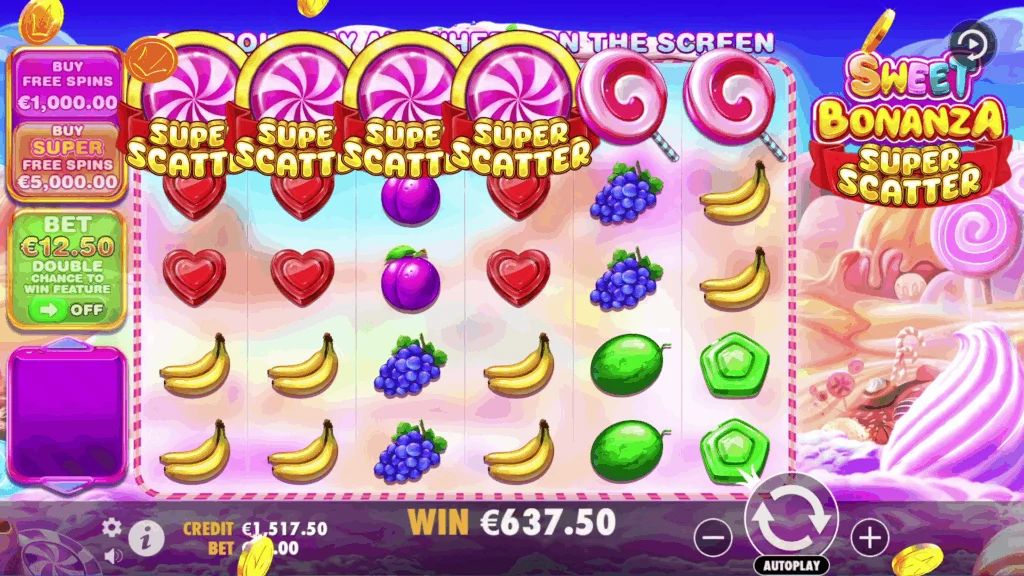


Sweet Bonanza 2 Demo — Architecture & RNG Integrity
Sweet Bonanza 2 Demo operates on the same mathematical framework as the real-money version of the game. The demo environment does not alter the underlying Random Number Generator (RNG), volatility model, or symbol distribution logic. It uses identical probability mapping and payout weighting structures. The only structural difference is the use of a virtual balance instead of real currency.
The RNG functions independently of session history. Each spin represents an isolated event generated through a certified pseudo-random algorithm. Previous results do not influence future outcomes. The demo version therefore mirrors the same independence principle that defines the real-money environment.

Identical Mathematical Core
The core mechanics include:
- Cluster-based payout logic
- Tumble (cascade) mechanics
- Multiplier-triggered amplification
- High-variance payout distribution
- Feature-based volatility expression
The RTP percentage represents a long-term theoretical return model calculated over millions of spins. It is not a session guarantee. Short sessions may diverge significantly from the theoretical RTP due to distribution variance.
This distinction is essential in demo mode.
Demo does not “warm up.”
Demo does not become “looser.”
Demo does not simulate easier outcomes.
The probability mapping remains constant.
Volatility in Demo Mode
Sweet Bonanza 2 is structured as a high-variance slot. This means the distribution prioritises less frequent but more concentrated payout events over steady micro-returns.
In practical terms, this creates:
- Quiet sequences
- Intermittent cluster activity
- Feature-dependent payout spikes
- Multiplier stacking during bonus states
Demo mode allows observation of this rhythm without financial exposure. However, the psychological perception of risk differs. When no real currency is involved, behavioural interpretation may shift. Players often tolerate longer neutral stretches in demo than they would in a live environment.
The volatility itself does not change.
Only perception does.
Demo as Structural Exploration
Demo should be treated as an analytical environment rather than a predictive one.
It allows examination of:
- Cluster frequency behaviour
- Multiplier timing density
- Bonus trigger spacing
- Tumble chain probability
- Session pacing patterns
It does not predict:
- Personal outcome likelihood
- “Hot” or “cold” cycles
- Bonus timing
- Short-term profitability
The independence of each spin remains intact across both demo and real-money modes.
Distribution Variance
High-variance models like Sweet Bonanza 2 concentrate theoretical return inside specific states — typically bonus rounds combined with multiplier alignment.
Outside those states, the game may produce extended neutral sequences. This is not a malfunction or suppression pattern. It is a distribution design characteristic.
RTP expresses long-term equilibrium.
Short sessions reflect distribution randomness.
Demo mode allows safe observation of this contrast.
Over 20–50 spins, results may appear volatile or inconsistent.
Over 5,000+ spins, the theoretical structure becomes more statistically visible.
Understanding this separation is critical when evaluating demo performance.
| Profile | Fit | Why it fits (operator view) | What you’ll notice | Practical boundary |
|---|
Demo Session Behaviour & Volatility Distribution
Sweet Bonanza 2 Demo expresses the same distribution architecture as the real-money environment. The difference lies only in capital exposure. The underlying variance curve, feature weighting, and multiplier density remain unchanged.
In high-variance slots, session behaviour is not linear. It does not gradually “improve” or “cool down.” Instead, it reflects clustering mechanics — value may compress into fewer, amplified sequences.
Quiet Phases Are Structural, Not Suppressive
During demo play, extended neutral sequences are common. These phases are not signs of suppressed payout logic. They are structural features of a high-variance model.
In Sweet Bonanza 2:
- Base game activity establishes rhythm
- Tumbles create localised intensity
- Multiplier alignment defines spikes
- Bonus rounds concentrate distribution density
Outside feature states, event frequency may appear modest. This is not imbalance. It is allocation.
High-variance distribution often shifts theoretical return into fewer bonus-amplified cycles rather than steady incremental returns.
Feature Density vs Base Rhythm
The base game is primarily rhythm-building. It introduces cluster flow and tumble sequencing but rarely expresses full volatility potential.
The bonus state changes this profile.
Inside Free Spins:
- Multiplier presence increases
- Chain potential rises
- Payout compression becomes more visible
Demo mode allows observation of this structural shift without financial pressure. However, it should not be interpreted as predictive behaviour.
If a demo session shows early bonus entry, it does not imply increased likelihood in subsequent sessions. If it shows prolonged base activity, it does not imply a “due” trigger.
Each spin remains statistically independent.
Short Sample Illusion
One of the most common misinterpretations in demo play is short-sample bias.
Over 20–40 spins, outcomes can appear extreme:
- Rapid spike sequences
- Long neutral stretches
- Back-to-back feature triggers
- Complete absence of bonus states
All of these are valid expressions of variance.
RTP is calculated across millions of spins. A demo session does not approximate that scale. It only reflects a fragment of distribution.
Short sessions amplify emotional interpretation. Longer sessions reveal structural pacing.
Multiplier Rhythm
Sweet Bonanza 2 does not distribute multiplier presence evenly across time. Multiplier density aligns more frequently with feature states and cascade chains.
This creates a visible “rhythm” pattern:
- Base stabilisation
- Tumble activity
- Multiplier alignment
- Feature escalation
But this rhythm is descriptive, not predictive.
Demo helps identify how these components interact — not when they will next align.
Psychological Separation
Demo sessions remove financial tension. This changes behavioural interpretation.
Without monetary risk:
- Quiet stretches feel observational rather than frustrating
- Spike events feel analytical rather than emotional
- Bonus rounds are viewed structurally rather than as outcome drivers
However, the game model remains identical.
The mathematical engine does not distinguish between demo and real-money environments.
The difference exists only in user perception.
Multiplier Rhythm & Tumble Escalation Logic
Sweet Bonanza 2 is often described through its visuals and feature names, but the practical behaviour is defined by how tumbles and multipliers interact with a cluster-based pay model. In demo mode, this is the most useful layer to study, because it explains why session pacing can feel uneven without implying any prediction.
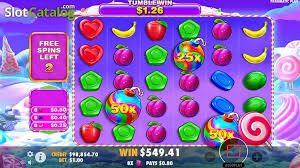
Tumbles Create “Intra-Spin Density”
A standard line slot typically resolves a spin once. Sweet Bonanza 2 can resolve multiple events inside a single spin cycle:
- A cluster forms
- The cluster pays and disappears
- Symbols tumble into the grid
- A new cluster may form
- The cycle repeats until no win occurs
This mechanism increases intra-spin density — the number of meaningful events per round. Importantly, it does not turn the slot into a “momentum” machine. It simply gives a single spin more room to express variance.
In demo mode you can observe:
- how often cascades appear at your stake level
- how frequently cascades chain beyond one step
- how cluster sizes behave during chains (small vs larger groups)
But you cannot infer:
- that cascades are “more likely” after a quiet stretch
- that a chain “should continue” once it starts
- that the next spin is influenced by the previous one
Multipliers Are Not Frequency — They Are Magnitude
Multipliers in Sweet Bonanza 2 are best understood as magnifiers of already-formed wins. They do not create wins. They do not raise hit rate. They increase the value of a win when the win condition is already met.
This is why sessions may feel calm for a period and then suddenly become spiky:
- the base layer produces clusters
- tumbles sometimes chain
- only a subset of those chains align with multiplier presence
- alignment compresses value into fewer, higher-intensity moments
The slot’s volatility is therefore not simply “high because big numbers exist.”
It is high because return density is unevenly distributed across time.
Rhythm Is Descriptive, Not Predictive
Players often notice what feels like a “rhythm”:
- quiet base phase
- a short tumble-heavy phase
- a multiplier appears
- intensity spikes
- activity cools again
Demo mode makes this rhythm easier to see because there is no cost attached. But the rhythm should be treated as descriptive of distribution, not predictive of the next event.
High-variance models can create clusters of intensity simply by random alignment. That alignment does not imply a repeating cycle.
Why Demo Can Mislead Here
Demo sessions can exaggerate interpretation in two common ways:
1) Over-weighting a single spike
A short demo session where one amplified sequence occurs can create a false sense of “how often” it happens. In high variance, a single event can dominate the entire session narrative.
2) Over-reading quiet stretches
A dry stretch can feel like a system “withholding” features. In reality, high-variance distributions naturally create droughts. The absence of intensity is part of the design, not a signal.
Operator View: What to Measure in Demo
If you want demo to be informational, treat it like a structural audit:
- How many tumbles per 100 spins feel typical?
- Do multiplier moments appear mostly in bonus states or sporadically in base?
- Does the game’s pacing encourage reactive decisions (e.g., “one more spin” drift)?
- Are you comfortable with the time it takes for intensity to appear?
This framing keeps demo evaluation grounded. It avoids turning randomness into narrative, and it keeps RTP in its proper place: a long-term model, not a session promise.
| Topic | Fit | What demo can show | What demo cannot prove | Operator boundary |
|---|
Demo vs Real-Money Environment — Structural Similarity, Psychological Difference
Sweet Bonanza 2 Demo and the real-money version share the same mathematical engine. The Random Number Generator, volatility model, cluster thresholds, and multiplier weighting are structurally identical. No separate probability profile exists for demo mode.
What changes is not the distribution — it is the context.
Identical Core, Different Exposure
In both demo and real-money environments:
- Each spin is independent
- Cluster formation rules remain constant
- Tumble chaining follows fixed logic
- Multiplier weighting does not shift
- Bonus trigger conditions remain unchanged
There is no “demo bias.”
There is no increased or decreased bonus frequency in demo mode.
However, demo eliminates financial exposure. That single difference alters behavioural interpretation.
Psychological Compression and Expansion
When no monetary value is attached to a spin:
- Quiet phases feel observational rather than frustrating
- Spikes feel analytical rather than emotionally charged
- Bonus rounds feel structural rather than outcome-driven
In a real-money context, identical sequences may feel different because perceived risk influences attention and memory.
High-variance slots like Sweet Bonanza 2 amplify this effect.
Because return density is uneven, a session may include:
- Extended neutral sequences
- Short but amplified cluster alignments
- Feature rounds that dominate the session narrative
In demo, those amplified rounds are interpreted as volatility expression.
In real-money play, they may be interpreted as success or recovery.
The mathematical model does not change.
The psychological framing does.
RTP and Session Scale
Return to Player (RTP) is a long-term theoretical average measured across very large sample sizes. Demo mode does not accelerate convergence toward that average.
Short demo sessions often exaggerate variance:
- A single amplified sequence can distort perception
- A prolonged neutral phase can feel disproportionate
- Rapid bonus triggers can feel predictive
None of these impressions reflect structural bias. They reflect small-sample distribution behaviour.
Understanding this separation helps prevent misinterpretation.
RTP is not a session goal.
It is a statistical model.
Observational Use of Demo
Demo is most useful when treated as:
- A mechanics familiarisation tool
- A pacing observation environment
- A volatility tolerance assessment space
- A UI and rhythm evaluation layer
It is not useful for:
- Testing “winning strategies”
- Forecasting bonus timing
- Measuring short-term fairness
- Validating outcome expectations
Sweet Bonanza 2 expresses volatility through concentration, not consistency. Demo allows safe observation of that concentration pattern.
Structural Takeaway
High-variance slots are defined by uneven return distribution.
Demo reveals how that unevenness feels.
It does not convert unevenness into predictability.
The value of demo lies in interpretation clarity — not performance confirmation.
Distribution Variance & Long-Run Interpretation
Sweet Bonanza 2 Demo becomes most useful when volatility is understood not as “risk level” but as distribution structure. High variance does not simply mean larger multipliers exist. It means theoretical return is allocated unevenly across time.
In low-variance slots, return is spread across many moderate events.
In high-variance slots, return concentrates into fewer amplified sequences.
This distinction matters when interpreting demo behaviour.
Uneven Return Allocation
In Sweet Bonanza 2:
- Base spins may resolve with minimal activity.
- Tumble chains may create short bursts of density.
- Multiplier alignment compresses value into specific rounds.
- Bonus states increase amplification probability per spin.
Because of this structure, two sessions of equal length may feel radically different:
Session A:
- One amplified bonus
- Several moderate chains
- Few quiet stretches
Session B:
- Long neutral stretch
- One mid-density bonus
- Several low-activity spins
Both sessions can be fully consistent with the same RTP model.
Variance does not smooth itself across short time frames.
Why Short-Term Reality ≠ RTP
RTP is calculated across millions of theoretical rounds. It reflects mathematical expectation over scale. A demo session of 100 spins represents only a microscopic fragment of that scale.
In high-variance design:
- RTP convergence is slower.
- Sample deviation is larger.
- Emotional perception diverges more easily from expectation.
This is not a flaw. It is a structural characteristic.
If a demo session appears highly positive, it does not indicate future bias.
If it appears flat or negative, it does not indicate suppression.
The gap between short-term result and long-term model is where variance lives.
Multiplier Distribution Is Conditional, Not Progressive
One common misconception is that multiplier intensity “builds” across a session.
In reality:
- Multipliers appear conditionally within spin resolution.
- They amplify wins when alignment occurs.
- They do not accumulate across spins.
There is no progressive memory.
There is no multiplier carry-over effect.
Each round resets the probabilistic framework.
Demo allows observation of how frequently multiplier alignment feels visible within a given session window. It does not allow estimation of future alignment timing.
Bonus Concentration Effect
High-variance slots often concentrate payout potential inside bonus states. Sweet Bonanza 2 follows this architecture.
In demo mode, this becomes visible:
- Base game establishes rhythm.
- Bonus state increases multiplier density.
- Distribution compresses into fewer but stronger cycles.
This can create a perception that “most value lives in bonus.” Structurally, bonus is where volatility expresses itself most clearly — not where guarantees exist.
Bonus rounds are amplification environments, not outcome assurances.
Session Length and Perception Stability
Longer demo sessions provide better context for interpreting volatility behaviour.
Over extended windows, you may observe:
- Multiple quiet stretches
- Several moderate-density cycles
- One or two high-intensity alignments
- Cooling phases following spikes
This wider view reduces narrative bias.
Short sessions exaggerate extremes.
Long sessions clarify distribution shape.
Neither changes the mathematical foundation.
Demo as Structural Lens
When used correctly, demo mode answers structural questions:
- Does the pacing feel acceptable for your tolerance?
- Are you comfortable with quiet distribution segments?
- Does high-intensity clustering feel readable rather than chaotic?
- Does multiplier alignment feel understandable?
It does not answer performance questions.
Sweet Bonanza 2 is not designed to produce linear reward patterns. It is designed to create contrast between calm and spiky states. Demo mode reveals that contrast without financial distortion.
Understanding this contrast is more valuable than attempting to extract predictive meaning from it.
FAQ — Sweet Bonanza 2 Demo
1. Is the demo version mathematically identical to the real-money version?
Yes. Sweet Bonanza 2 Demo uses the same RNG logic, volatility model, cluster thresholds, and multiplier weighting as the live environment. The only difference is the absence of financial exposure.
2. Does demo mode change bonus frequency?
No. Bonus triggers follow the same probabilistic structure in both demo and real-money play. Short sessions may feel different due to variance, not because of altered mechanics.
3. Can demo sessions approximate RTP?
Not reliably. RTP is a long-term theoretical return calculated across very large sample sizes. A demo session of 50–200 spins does not meaningfully approximate that scale.
Short-term results may deviate significantly from RTP expectations.
4. Why do some demo sessions feel extremely quiet?
Sweet Bonanza 2 operates on a high-variance distribution. This means return allocation is uneven. Extended neutral stretches are structurally normal and do not indicate suppression or bias.
5. Do multipliers become more likely after a quiet phase?
No. Multipliers appear conditionally within spin resolution and do not follow progressive logic. Each spin is statistically independent.
There is no “due” multiplier effect.
6. What is the correct way to use demo mode?
Demo should be used to:
- Understand cluster mechanics
- Observe tumble behaviour
- Study multiplier interaction
- Assess volatility tolerance
- Evaluate pacing and UX comfort
It should not be used to forecast outcomes or validate expectations of profit.